Friday, 6 November 2015

Camera Workshop 4

Camera Workshop 4 - 26th October

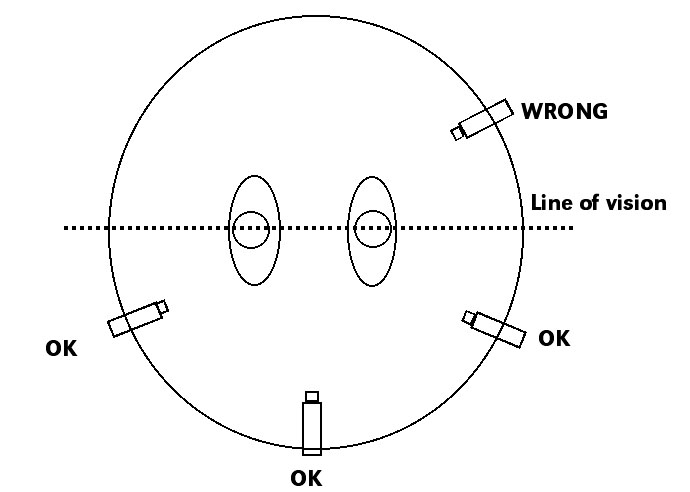
Today we did some more camera work on the set of the Jools Holland show with Fergus. We learnt about the 180 degree rule and how to implement it when filming. Though I have had no prior experience doing this technique, I knew of the 180 degree rule before.

In film making, the 180 degree rule shows two subjects opposite one another with an imaginary arc surrounding them showing where the camera must be. Should the camera be outside of the arc, this is called crossing the line.


Fergus (far right) teaching me how to operate some of the
functions on the camera
The task we were issued with in todays workshop was to create a short video using a script and including audio while sticking to the 180 degree rule. To help put this video together, I worked with Alex and Josh who were the actors and Leonardo who was working the sound. All in all I was happy with the shots I got though I was a little disappointed with the sound as some of the clips had quiet audio. Despite this there were some good audio pieces and I am still able to edit the piece without any issues.

I also had the chance to use the boom mic and I felt that I did really well and had very few issues keeping it out of shot while maintaining a good piece of audio. All in all I had a very good experience working with both the camera and the boom and felt I learnt a lot from this lesson.

Camera Workshop 3

Camera Workshop 3 - 19th October 2015

Today we started to look at trailers as well as different camera shot sizes, angles and techniques that would enable us to create a very effective opening sequence or trailer.

Camera Shot Sizes
There are a number of different shot types that you can film, some of which I have mentioned in previous post. These range from Extreme Close-Up (ECU) right the way up to Very Long Shot (VLS). To the right are the most common examples of shot sizes.

Very Long Shot (VLS) is used to show the entire character as well as their surroundings. It can be very difficult to make out certain characteristics from the subject.

Long Shot (LS) is used to show the entire character but not much else. In this shot the character will often fill the screen from head to toe.

Medium Long Shot (MLS) is used to show most of the character, typically from the head to the knee area.

Medium Shot (MS) is used to show roughly half the character so the head and torso.

Medium Close-Up (MCU) is used to show a small area of the characters body, typically the head and shoulders. This is typically used in Over The Shoulder shots and in interview situations.

Close-Up (CU) is used to show an even smaller area of the body, typically the head.

Big Close-Up (BCU) is used to show just the characters face meaning the chin and most of the hair is left out of the shot.

Extreme Close-Up (ECU) is typically used to show facial features, most commonly the characters eyes.

Camera Shots and Angles
There are numerous ways you can shoot a scenario, you can have multiple people in a shot, you can shoot from over the shoulder, shoot from a high angle etcetera. There is no limit on how you can take a shot but here are a few examples:

Two Shot is used to get two different subject in the same shot. This could be implemented in a number of fashions such as Close Up, Medium Close Up and Medium Shot. You can also have more than two people in a shot but this is harder to implement.

Over The Shoulder Shot is where the field of view shows what the subject is looking at/talking to from over the shoulder.

High Angle Shot (looking down) is where you are viewing a subject or a scenario from above, looking down. This can be done to make a character look small and weak.

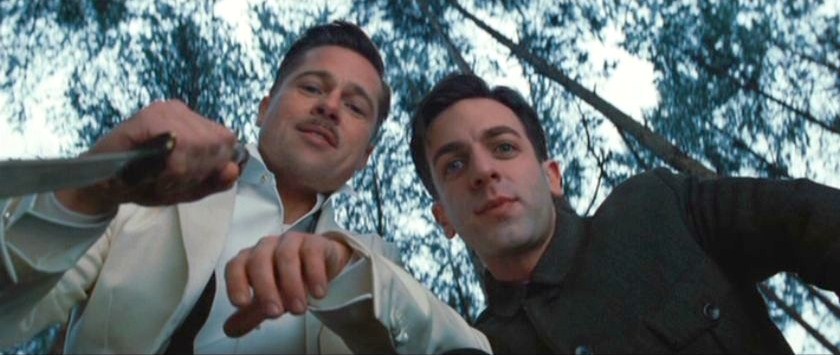
Low Angle Shot (looking up) is where you are viewing a subject or a scenario from below, looking up.  This can be done to make a character look more empowering (See image below for an example).

Tilted Frame is where the camera shot is at an angle.

A low angle shot from Inglorious B******s

Wednesday, 4 November 2015

Camera Workshop 2

Camera Workshop 2 - 12th October 2015

Today was our second camera workshop with Fergus and we worked on the set of the Jools Holland Show in studio 5. For this workshop, we were issued the task to create a sequence around someone walking towards a chair. Once again we used the Sony EX cameras. We learned more about the features on the camera as well as some new features. One feature that we were taught was how to sort out the aperture and other controls such as gain, white balance and zebra.

Being new to camera operating, there was a lot that I learnt. The studio had a lot of areas that showed up as dark on the camera so to learn these new features was very useful and I feel as though I could take a lot from it as one of the areas I am planning on shooting at is inside and very dark. I found the zebra tool most useful as it shows you on the camera the areas that show up as too bright allowing you to get the most ideal shot for your video.

Our task in pairs was to create a video using a number of short sequences that would cut up to create one video once the video is edited. For this task I was paired up with Josh Bayly. We used a number of different shots and took in turns using the camera so I would film Josh and Josh would then film me. The different shots we used included a Close-Up shot of his feet as he walked from one chair to another side on, the same shot only with the camera following the feet from behind, one with the subject walking towards the camera, starting as a Long Shot and finishing on an Extreme Close-Up shot as well as a range of other shots from numerous different angles while sticking to the 180 degree rule (to be discussed in Camera Workshop 4).

The lighting in the room was consistent throughout the shot and I did not feel the need to change the aperture by huge amounts with each shot. I did find this difficult as there was a lot to focus on in such short time. I took my time getting the lighting in each shot clear but I did not want to spend too long as I wanted a good number of shots in this time.

Story-Telling - Memento

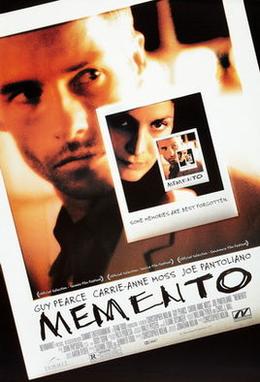
In a recent lecture, I sat and watched one of Christopher Nolan's first major hits, Memento (2000). The film was both written and directed by Christopher Nolan and starred Guy Pearce who played a man named Leonard Shelby, who must face the task of finding his wife's killer while facing the handicap of not being able to remember anything after about 15 minutes. To do this, Leonard must take pictures of certain people/scenarios and write notes as well as tattoo certain bits of information to his body to remind himself of the numerous points he has pointed out along the way.


What particularly interests me about this film is the way the story is structured, it starts at the end and works its way to the beginning. What impresses me even more is that it still manages to offer some unexpected surprises making the end result all the more significant. I feel that by structuring a film in this way you are able to create something that seems so incredibly complex and complicated from a story that in actual fact is very simple. For this reason I very much enjoyed watching this film as it really makes you think about what is going on as well as what is about to happen.

I do not feel that I can make any direct links from my short film to memento and I do not think I can take any ideas from the film however I do like the many meeting scenarios Leonard has in the film. As Leonard has no short term memory, It seems as though every time he talks to someone he is meeting someone new, even if that character has popped up numerous times in the film.

Draft script for Memento, dated 10/04/1999
Above is a draft script taken from the film Memento, written in April 1999, that I found using the website Script-O-Rama. I was recommended to use this website to find numerous scripts taken from films, TV as well as Anime by Simon as a way of finding script examples to help us with script layout as well as inspiration.

I found the script layout very helpful as it portrayed exactly how to lay out written messages as well as voice-overs, phone calls and parenthesis.

Tuesday, 20 October 2015

Camera Workshop 1

Camera Workshop 1 - 5th October 2015

Today was my first time using the Sony EX cameras and it was great learning about the many ways you can use the camera to shoot a film. This was my first workshop with Fergus and he showed us through the many options available on the camera as well as the basics of adjusting the focus and zoom on the camera. The main point of this workshop was to operate the camera as well as selecting the right frames.

In this workshop we were issued with two tasks, the first being setting up a focus, also known as a rack focus which is when the focus switches between two people/subjects in the same frame. This meant setting up the camera, having the two subjects, in this case Matt and Alex, framing the shot and then using the focus ring to switch between the two subjects. To make this task easier, I had Matt and Alex stand a few feet from one another so that I could focus between them a lot easier. Fergus then stepped up the challenge and had us focus between two people while they were on the move. To do this I had to use both the zoom control as well as the focus ring to keep both subjects in shot as well as focus between them. As I lack any real experience with a camera I found this task increasingly difficult as both subjects were out of focus as well as slightly out of shot. Despite this I feel that I have learnt a lot from this experience and feel that I could definitely improve the next time around.

For the next task we practiced framing. We did this by pulling off a number of different camera shots and angles to film a scene involving a bag. We were given a number of different shot types and were told to use at least 5 of them. It was decided that I would be on the camera as I lack the most experience and I felt that I needed to gain some more experience for the future. Though some of the shots were a little off and one of the scenes was a lot darker than the others, I felt I did okay and was happy to gain a bit more experience on the camera.

Once done we edited the footage to create a short video. Colour correction was used so that the discolouration was not noticeable and music was added to add drama to the scenario. This was the end result:

Monday, 12 October 2015

My film moment

My film moment - Pulp Fiction: I shot Marvin in the face

Having gone through what a script should contain with professional script writer Steve Coombes, I was given the task of finding my favourite moment from film or television. I found this task very difficult as there were a number of moments I have enjoyed from both film and television from shows such as Breaking Bad and Game of Thrones as well as films such as Fight Club and Reservoir Dogs.

The moment that stood out for me however was from a film I have watched very recently, Pulp Fiction. The scene in question is called I shot Marvin in the face.


In this scene Vincent Vega (John Travolta) questions Jules Winnfields (Samuel L. Jackson) judgement when he claims to have witnessed a miracle. Vince then turns to a young man named Marvin asking what his opinion is on the matter which results in Vince accidentally shooting Marvin in the face.

Friday, 2 October 2015

The meeting

The Meeting

25 word pitch
A young girls deteriorating life results in depression and drug abuse, until she meets a young drug dealer who she discovers to be worse off than her.

Characters
Cindy (the young girl)
-  16 years old
-  short in height
- typically seen wearing a tracksuit
-  very smart
-  depressed
-  pale face and baggy eyes (always looks tired/ill)
-  sympathetic

Backstory: During school time, Cindy often kept to herself and was really excelling in a number of subjects, especially english. Though she was reasonably satisfied with her day-to-day lifestyle, she wanted to become more outgoing. This is where she was first introduced to drugs. On a night out with friends, one of them offered her some weed. She wasn't hooked on the stuff but eventually started to go out more and more often and started to smoke more and more weed, abandoning her studies and revision periods. Her life really turned around when her parents got a divorce shortly before exam period which led to poor results. This is where she fell in a state of depression and started using drugs as an escape from her depressing life.

Reece (the drug dealer)
-  19 years old
-  average height
-  always wears tracksuit and sportswear
-  lack of english skills
-  always on edge/very jumpy
-  from a poor background

Backstory: Due to a number of issues in his family life, Reece decided to drop out of school at a young age to take care of his family. With no money and nowhere else to turn to, Reece decided to get involved with the distribution of drugs ranging from weed to cocaine, occasionally contributing to the production of the drugs. Though he made good money from this, the money was spent on alcohol by the mother and drugs by the father, eventually leading to his fathers demise.

Genre
The story is a very dramatic story and can at times leave the viewer on the edge of their seat. I would say that it is a drama/thriller short film as the story falls on a rather dark and depressing story and though the two main characters do develop a bond and a good, trusting friendship, it doesn't really go any further than that which adds to the drama. There will be a bit of action and a lot of conflict but not such much so to consider it an action. It will certainly keep the viewers on the edge of their seat.