Seeing as I was unable to use one of my locations, I have decided to change how the story of the film is set out, however the idea and directorial vision remain the same. The original story was a young boy looking to make it into a football team, however frequent mistakes and errors in simple day to day activities puts him in a situation where he starts to doubt himself before coming home to a letter congratulating him for making it into the team. The new story is of a young man preparing for his very first job interview, however he becomes worried and disorganised, with toothpaste ruining his suit and tea ruining his change of suit. All before he gets a call from his potential boss telling him that the interview has been moved to another date, allowing him more time to get reorganised.
The idea that the time of day will go backwards while the character progresses forwards however will remain the same. Shots starting from the window will enable the audience to recognise that the day is going backwards though some shots will be more subtle than others, depending on what is going on in the scene.
The clothes the character will be wearing will be grey and blue, grey representing the bleak day the character is having and blue representing his mood. The clothes will be somewhat out of place and will look scruffy as I feel that this will best convey that he is nervous and in a hurry. Though the film will appear to span over a period of a whole day, the characters actions will only take place over a period of about 30 minutes and the rapid progression from the night sky to day time represents how quickly his day is going backwards.
It is the responsibility of the Director to ensure that everything and everyone on set is moving in the right direction. It takes a group of people to make a movie, and the director is the "conductor" of this group. The Director simply makes sure everyone is doing their job and it is the groups job to add their own style. Though it is the Director that has the ultimate say on set, there is always collaboration between him and the DP, makeup, set design, head gaffer, camera operators, and all department heads. With all that being said, I want to talk about the two different directing styles seen in a number of movies today. For the most part the directors who focus on the visuals, or on the actors performance. Each director has their own blend of the two. This makes me ask myself, what director am I? Do you tend to focus on the performance of the actors, or on the way the movie looks. The best director can focus on both and use them to tell a compelling story. For my short piece I will be focussing mostly on the visuals. I want to make the setting feel the way it's supposed to feel. I want to trust the actors to do their part well. This brings me onto the next topic, you want to have actors who are talented enough to make the character their own. A quality actor will be able to bring the character to life. Before you even start filming you need to know what style the movie is going to be, and what type of lighting you want for each scene. Once you have a good style plan, you need to work with your director of photography and make sure you are collaborating, so that he can light a set while you work with the actors. Once a set is light, you can make your visual adjustments with lighting changes, lens choice, and camera position. Before you start rolling, you must talk to the actors and tell them where they are at. They need to understand what emotions they need to portray and what has happened to their character up to this point in the story. Because you casted well, they can take some simple direction and make that character come to life. There is a lot more to directing than this, but this will give you a good foundation. Don’t take on the whole load yourself, collaborate with your DP in visual style so that you can work with the actor and juggle all other on set responsibilities.
Few people have had as much impact on The Sopranos as Phil Abraham, who had held the role as camera operator (4 episodes), cinematographer (47 episodes) and even directed an episode. Though Abraham is more established as a cinematographer, Abraham has directed a total of 59 episodes across 29 different TV series including The Walking Dead, Breaking Bad and most frequently Mad Men for which he has directed 15 episodes.
Abraham's directorial debut came with the iconic TV series, The Sopranos for which he only directed one episode across the whole series. However his role as director in this series would see him direct in a number of some of the most iconic TV shows of today. He even had the chance to direct the opening two episodes of the major Netflix series, Daredevil, which set the tone for the rest of the series.
Phil Abraham likes to challenge actors with some ambitious takes, he likes to stick to the script and likes to keep it that way, even if the shot is deemed too hard to shoot. One of the most iconic scenes Abraham directed was the one shot fight scene in the acclaimed Netflix series Daredevil, which saw Daredevil take on a room full of thugs in an epic 3 minute shot. There was not a single cut in this shot and to make this scene possible they made a few Texas Switches between the actor and his stunt double and took about 7-8 takes before the scene was complete. The cast and crew asked if they could do a few wipes as the scene was too complicated to achieve but Abraham was adamant that a one shot fight scene with no cuts would be better.
It was the one shot fight scene that got me particularly interested in Abraham and I am especially interested in his overall style. When he directs an episode, he wants to keep the episode on the same path as the rest of the episode but aims to create that special, iconic scene. He has done this with Mad Men, The Walking Dead and as mentioned earlier, Daredevil. I would like to implement a shot of great importance that is similar in fashion to some of the most iconic looks in TV, and Abraham is a great example of someone who did just that.
Quentin Tarantino is a screenwriter, director and actor known for a number of films such as Pulp Fiction, Reservoir Dogs, Django Unchained and Kill Bill as well as the TV series From Dusk Till Dawn.
Tarantino started his career writing screenplays for Video Archives such as Natural Born Killers and True Romance. He then left Video Archives for a production company called Cinetel. Tarantino was able to submit one of his first screenplays through a producer he knew. The screenplay was True Romance. Director Tony Scott was so impressed he decided to buy the rights off of Tarantino.
It wasn't until 1992 where Quentin Tarantino made his directorial debut with the film Reservoir Dogs. Despite the small budget, Reservoir Dogs was a hugely popular film globally and received high critical acclaim, making Tarantino one of the most talked about directors in Hollywood at the time. Tarantino also wrote the screenplay for this film and even starred as one of the characters. Tarantino's most successful and most highly acclaimed film to date, Pulp Fiction, was released just two years after his first film Reservoir Dogs. The film went on to win an Academy Award for Best Writing in 1995 and won the prestigious Palme d'Or a year earlier. His most recent film, The Hateful Eight, has received mixed reviews, some praising the outstanding dialogue and storyline while others criticise the excessive bloody violence and the use of racist remarks throughout the film.
Though Tarantino considers himself more of a screenwriter than a director, he brings his own directorial stamp into his films that separates him from the rest. For example Tarantino uses a wide range of camera techniques including crash-zooms, low angle shots and long takes. Another trademark of Tarantino's is his use of music, he has stated that he does not like to hide slow cinematic moments but should only be used to enhance the action. Though Tarantino's films are considered very violent, a lot of the action that goes on in his films tend to happen off camera. This is called implied violence. Below is a video showing a recurring shot in Tarantino's films, the trunk shot.
It is Tarantino's camera techniques that interested me most and is certainly something I can look at more closely in hope that I am able to replicate some of these techniques in ways that are relevant to my Drama Film. I also hope to add my own little twist to some of these techniques by perhaps blending two of these techniques together or perhaps pairing one with a more uncommon technique.
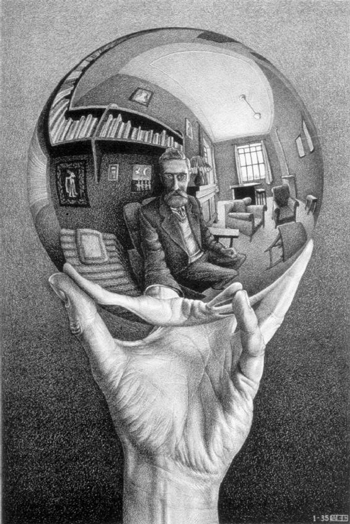
Maurits Cornelis Escher was an artist widely admired by mathematicians and scientist for his unusual artwork made with the techniques of woodcuts, lithographs and mezzotints, all inspired by mathematics. Though Escher did not follow any movement, he was considered a pioneer of psychedelic art by the hippy counterculture in the 60's.
To the left is the ever famous Hand with Reflecting Sphere which is a portrait of Escher's reflection in a spherical mirror ball which also shows Escher's studio. This image can be interpreted in a number of ways, depending on what the viewer sees or wants to see. For example one interpretation is that Escher has his life in his hands which conveys control. Another interpretation is that there are two reality's, one being Escher himself and the other being his reflection. This can symbolise how Escher sees himself, perhaps as a distorted characters with almost no general direction.
I can take the latter as a great interpretation of my character in the portrait film. My character will see himself as a distorted and directionless character that feels almost too different from everyone else in his surroundings. I was thinking about giving my portrait film a very distorted look in certain areas depending on what is going on in the characters head at that given moment.
Salvador Dali was a famous artist known for his outstanding self-publicist acts and for his incredible showmanship. Dali is especially well known for a wide range of art forms, ranging from paintings, sculpture work, graphic designs and photography.
To the left is one of the self-portrait paintings Dali did called Soft Self-Portrait with Grilled Bacon. Dali argued that the most consistent thing about representation is in fact the skin rather than the spirit or vitality. The side of bacon is a representation of organic matter of the every day life.
The image consists of a number of crutches helping keep the character up and the colour tone is consistently dark and brown which can convey the every day struggles this character has to go through. I like to perceive the message as a character struggling though coping with every day life and despite these struggles he keeps on fighting. I see the bacon as a representation of the little rewards you will get after going through these struggles.
I find this very relatable to my piece as my portrait film goes into the details of how someone will claim these little rewards having had one of the most mistake filled days of their lives and almost looks as though nothing could possibly go right. These rewards can be conveyed in a number of ways, some more subtle than others, this can take the form of a piece of fried bacon (as presented in the portrait above) or a letter (as presented in my portrait film).
As a part of our directions unit, I have been asked to create a short portrait film, roughly 1-2 minutes long, and should introduce introduce myself and my directorial vision. This can take the form of a certain style, approach or even a director while still remaining original and to our own.
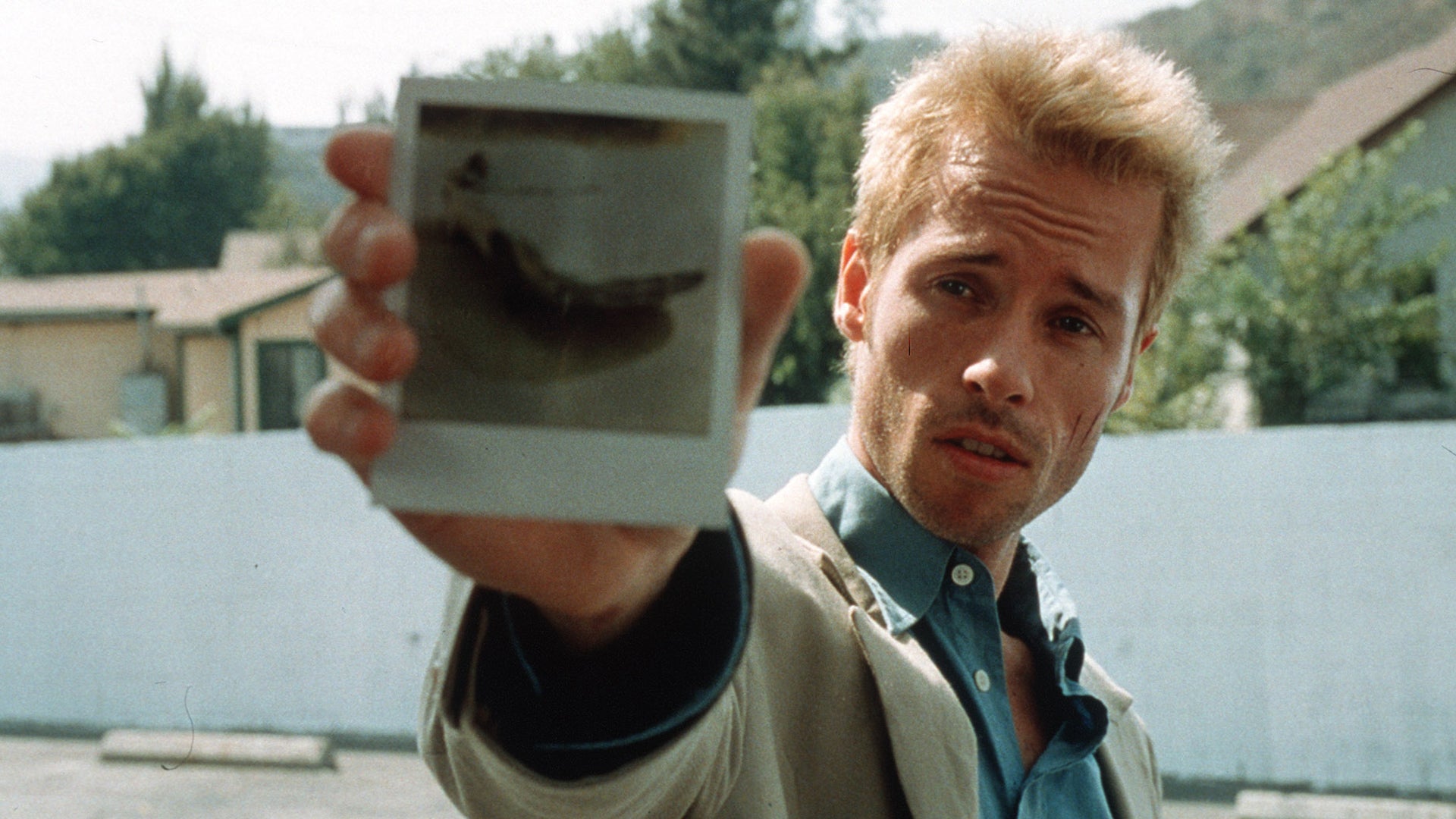
For my portrait film, I have decided to take a similar approach to the one taken in the film Memento by Christopher Nolan. In the film the entire story is told backwards without giving anything away in the beginning.
Guy Pierce starring in the film Memento
In my film I have decided to have the film begin at the end of the day and finish at the beginning of the day, like Memento. However unlike Memento the story will still be progressing forward. Throughout the story the main character will be making countless errors and then by the end of the film will return home to find that their goal has been achieved. The idea is that the backwards day is a representation of what the characters day has been like (backwards) and the mistakes followed by the achieved goal supports the message that if you keep making mistakes you will eventually learn from them and achieve your goal.
As for sound, dialogue must remain minimal and there can not be any music. I will feature a number of different ambient sounds throughout, all relevant to the story with scripted dialogue used only in the final 5 seconds of the film.